Unprocessed FAQ: Sugar & Sweeteners

October 1, 2019
I hope your October Unprocessed challenge is off to a fantastic start!
(If you haven’t taken the pledge yet, please do it today. If you already eat this way all the time, take the pledge and show your support! And if you think it’s too daunting, how about just for two weeks? Or even a day? Do what you can, and take charge of your health!)
I’ve been getting a lot of questions about sugar and sweeteners, and whether or not they pass the Kitchen Test. In the past years of the challenge, the consensus seemed to be that date sugar, evaporated cane juice, raw/unfiltered honey, and maple syrup would all be acceptable sweeteners. An approximation of Turbinado and Muscovado sugars could probably be made at home, too, though the current industrial process to make them is probably a little bit different than what you’d be able to do at home.
Ultimately, sugar is one of those gray areas where you’ll need to figure out where it makes sense to draw the line for yourself (for artificial sweeteners, it’s much more of a no-brainer). Below are some more thoughts on a few of the most common ones, and if you want more details, check out my post on various sugars.
“Sugar”
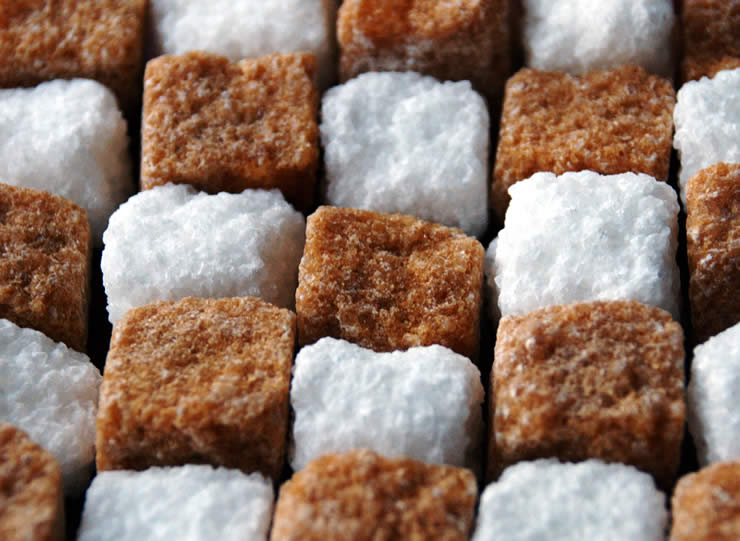
Usually, the term “sugar” refers to bleached table sugar, those fine-white granulated crystals that come from sugar cane or sugar beets. The bleaching is done with sulfur dioxide, an ingredient that hopefully isn’t in your pantry.
The terms “sugar,” “granulated sugar,” “cane sugar,” “pure cane sugar,” “beet sugar,” and “table sugar” all refer to the bleached stuff. So if you just see any of those on the ingredient list, it’s probably that (though the only way to know for sure is to ask the company).
Verdict? Regular sugar doesn’t pass the kitchen test, but… some folks make deliberate exceptions for sugar — simultaneously making an effort to reduce their sugar consumption throughout the month. Sounds like a good idea to me!
Brown Sugar
Regular “Brown Sugar” (the kind you get in the box at the grocery store) is usually just refined table sugar with a small amount (3.5% to 6.5%) of added molasses–which is a byproduct of the sugar-making process in the first place (see below)… but since it goes through the refining/bleaching process first, it doesn’t pass the kitchen test.
Verdict? Unprocessed Fail.
“Raw” Brown Sugars (Turbinado, Demerara, Muscovado, Rapadura)
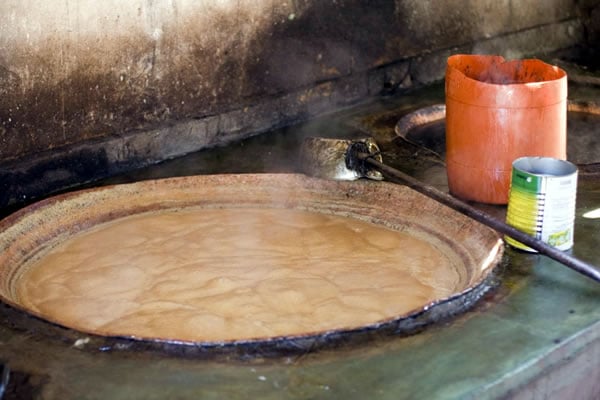
I think it would be possible to make something similar to these sugar crystals at home, if you had some sugar cane stalks ready to go. Although there are a couple of steps in the commercial process for some of these that you could not easily do at home, I’m guessing you could still get the crystals if you’re patient enough (perhaps a countertop food dehydrator would help evaporation).
I’ve seen many articles refer to these sugars as “unrefined” or “raw,” and that’s a bit misleading. They may be raw if they haven’t been heated, but they’re certainly not “unrefined” — they are simply less refined than other crystalline sugars. They start with sugar cane, extract the juice, then heat it to evaporate the water. Once the sugar crystallizes, it is often spun in a centrifuge (hence the name turbinado) to further dry the sugar and remove some impurities. (Demerara sugar is similar, but is originally named for the Demerara colony in Guyana. It’s now produced in Mauritius.)
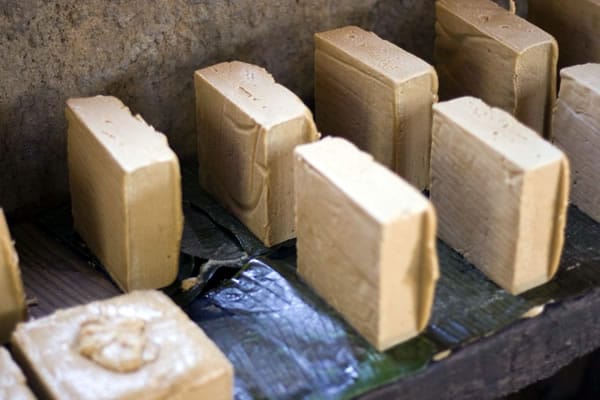
Muscovado sugar (also known as “Barbados Sugar”) is similar, but is dried without using a centrifuge. Similarly, rapadura is made from juicing (crushing) sugarcane and then simply evaporating the liquid over low heat. Of all of these choices, Muscovado and Rapadura are the least processed and most likely to pass the kitchen test.
Verdict? If you want a granulated sugar, shoot for Muscovado or Rapadura if you can find them. Beyond that, you’ll need to decide what’s right for you.
Honey
When it comes to unprocessed sweeteners, honey is one of my favorites. It’s important to note that some brands will process the honey and strip it of some of its nutrients. If you can find a good “raw” honey, it’ll be the closest you can find to what you’d get if you actually kept bees in your own backyard.
My favorite large-ish brand so far is Really Raw — it’s a creamy, rich honey that even has bits of pollen and honeycomb floating on the surface. (The downside is that it’s quite expensive.) But if you can find true local honey at your farmers market that’s probably even better.
Verdict? Raw honey passes the test easily; the more refined brands are better than table sugar, and I’ll leave it to you to decide if that’s okay.
Maple Syrup
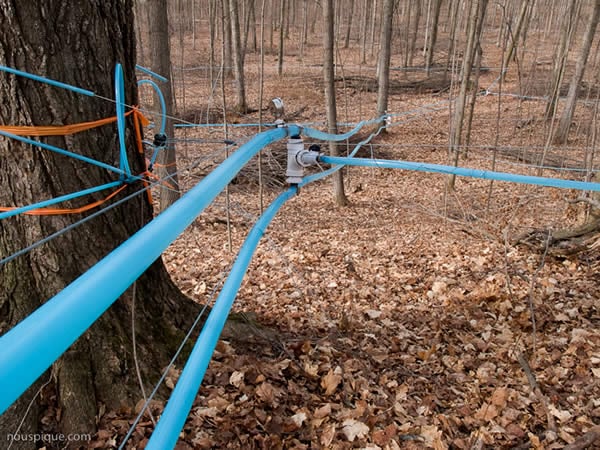
Maple syrup is my other sweetener of choice (though I still consume it in very small amounts!). Made from the sap of maple trees (the sap is collected and then boiled down), the process is fairly similar today to many years ago. Just be sure you’re getting real, 100% maple syrup — “Aunt Jemima” doesn’t count!
Verdict? Yep, Maple Syrup is good-to-go for October.
Agave Syrup
Often called “Agave Nectar” (thus giving it a more healthful tone), this sweetener comes from several species of agave plant.
I’ve heard people sing agave’s praises, specifically thinking it’s significantly less-processed than other sweeteners. That may or may not be true, as the sugar is extracted and processed through a few different methods, depending on the type of plant. It always requires more processing than honey. I just got caught in a long Google spiral of conflicting information – the description of the agave production process varies considerably, depending on the source. (Manufacturers downplay the processing, of course. Others think it’s as bad as high fructose corn syrup.) My assumption is it’s somewhere in between, and may vary from brand to brand. Most of the processing is done by heating, but there are likely steps with enzymatic involvement – thus making it tricky to do in your own kitchen.
Verdict? Most people think that the agave plant just flows with nectar, like maple sap. In fact, it takes a lot of processing to produce agave nectar. I’ll leave this one to you to decide, but for me, Agave’s out.
Brown Rice Syrup
Brown Rice Syrup is created by soaking/cooking brown rice with enzymes (usually from dried barley sprouts — meaning: barley malt) to break down the starches into accessible sugars. The liquid is then strained off and reduced to a syrup. It may also be produced by cooking brown rice flour (or brown rice starch) with enzymes — so your mental picture of simply boiling a pot of brown rice isn’t necessarily accurate.
As a sidenote, brown rice syrup has a “health halo” surrounding it because it’s made with brown rice (this has become a big pet peeve of mine). Don’t be fooled: It’s still concentrated sugar.
Verdict? I don’t think you could make brown rice syrup at home. Next!
Molasses
Unsulphured molasses and blackstrap molasses would likely pass the kitchen test. Wikipedia walks us through the molasses production steps:
“To make molasses, the cane of a sugar plant is harvested and stripped of its leaves. Its juice is extracted usually by crushing or mashing, but also by cutting. The juice is boiled to concentrate it, which promotes the crystallisation of the sugar. The result of this first boiling is called first syrup, and it has the highest sugar content because comparatively little sugar has been extracted from the source. First syrup is usually referred to in the Southern states of the USA as “cane syrup”, as opposed to molasses. Second molasses is created from a second boiling and sugar extraction, and has a slight bitter tinge to its taste. The third boiling of the sugar syrup yields blackstrap molasses, known for its robust flavour.”
(Note that Wikipedia continues, mentioning that Beet Sugar Molasses goes through a different process than Cane Sugar Molasses — but I’m pretty sure most of the Molasses sold in the United States is from cane sugar.)
Verdict? I think molasses probably passes the kitchen test, just as the other unrefined can sugars (like Muscovado) do. (Pro-tip: Try a little blackstrap molasses spread on toast in the morning, or in a hot beverage!)
Coconut Sugar
Coconut sugar has recently come into vogue as a healthier-sounding sugar (but it’s still sugar!). It actually seems like coconut sugar is relatively unprocessed: Sap from Coconut Palms is harvested and then cooked/evaporated over heat. Nutritionally, it’s similar to regular table sugar. However, a tree cannot be used to produce both coconut sugar and coconuts – so we may be causing some serious problems with the increased demand for this sugar.
Verdict? That sure sounds like someone could do that at home, thus passing the Kitchen Test.
Corn Syrup & High Fructose Corn Syrup
In reviewing this post for 2014, I just realized that I didn’t include corn syrups! When it comes to concentrated sugars, they’re about as processed as you can get. The Wikipedia description of how it’s made boggles my mind at the lengths humans will go to do some things:
“Currently, corn syrup is obtained through a multi-step bioprocess. First, the enzyme alpha-amylase is added to a mixture of corn starch and water. alpha-amylase is secreted by various species of the bacterium Bacillus; the enzyme is isolated from the liquid in which the bacteria are grown. The enzyme breaks down the starch into oligosaccharides, which are then broken into glucose molecules by adding the enzyme glucoamylase, known also as “gamma-amylase”. Glucoamylase is secreted by various species of the fungus Aspergillus; the enzyme is isolated from the liquid in which the fungus is grown. The glucose can then be transformed into fructose by passing the glucose through a column that is loaded with the enzyme D-xylose isomerase, an enzyme that is isolated from the growth medium of any of several bacteria.”
Corn syrup is almost all glucose. High fructose corn syrup takes it a step further, using even more processing to convert some of the glucose into fructose (which tastes sweeter than glucose). And the reason it’s so cheap and prevalent? Government subsidies.
Verdict? No, no, a thousand times no.
Stevia
Real, honest-to-goodness stevia is just the leaf of the stevia plant. If you can find that (or grow your own), or can find a powder that’s truly just the ground-up leaves, it’ll pass the test.
But the name-brand white powders, or the liquids with preservatives in them? You could not make those at home. Here’s a great post from a previous challenge about Stevia, Purevia, and Truvia.
Verdict? Real stevia — the leaves of the plant — is okay, but most of the stuff you can find at the store is not.
Monk Fruit (luo han guo)
A relative newcomer on the market is monk fruit, a vine that’s native to southern China and northern Thailand. Although the fruit is incredibly sweet (~300 times sweeter than sugar), it’s traditionally been used only for medicinal purposes, in tea, or in other foods that help mask some of its other flavors. In 1995 Proctor & Gamble patented a process for removing “interfering aromas” – which is what led to the products you now see on the shelves. They use solvents in the process, so it’s not going to pass the kitchen test.
The now-defunct product Nectresse®, from the makers of Splenda, listed these ingredients: erythritol, sugar, monk fruit extract, and molasses. So it’s not quite as pure as you might expect, and there’s more sugar than monk fruit in it! Then again, it died due to lack of sales, so maybe that’s a bit of sweet justice. (You can still find “Monk fruit in the raw” – which also does not pass the kitchen test.)
Verdict? Monk fruit isn’t very useful as sweetener in its unprocessed form, and the powdered versions are heavily processed.
Artificial Sweeteners & Sugar Alcohols
I may be pointing out the obvious, but you couldn’t make saccharin, sucralose (Splenda®), aspartame, Nutrasweet®, Equal®, acesulfame potassium, xylitol, erythritol, neotame, or any other of these kinds of sugar substitutes/sugar alcohols at home.
Verdict? Über-processed!
—
I’m sure there are plenty of questions, as I’m just scratching the surface here — so let’s keep the conversation going in the comments below!
And here are some of my previous posts on sugar:
- Sugar is Sugar is Sugar is Sugar!
- What is the healthiest sugar? (Part 1)
- What is the healthiest sugar? (Part 2)
- What’s in a gram?
- What I do not eat High Fructose Corn Syrup
If you haven't taken the October Unprocessed pledge yet, please do! And then encourage your friends to join in -- it's a lot more fun that way!
Sugar Cubes © 2008 Paul.
Garapa boiling in the tachão © 2009 Royal Olive.
Chunks of Rapadura © 2009 Royal Olive.
Maple Syrup Lines © 2010 nouspique.
Corn Syrup © 2009 Ben Simo.

















Very informative for someone who is somewhat still a novice. Thank you.
Great post Andrew. I’m pretty much agreed. Another sugar that is supposedly as natural as you can get is sucanat. The Wholesome Sweeteners site says that it is whole unrefined cane sugar, the least refined cane sugar you can find outside of a cane stalk. It’s also organic and fair trade which I like. It’s what I have in my pantry, although I use little of it. Sugar is definitely a treat. We were recently hiking in the Canadian Rockies at 7000 feet with 22 pound packs of camera great. Each day the chef tucked two gluten-free peanut butter chocolate chip cookies into our lunches for on the trail. They were such a treat, and I didn’t worry about eating them. We were burning a lot of calories. She shared her recipe, and I want to post it but when I saw the sugar. Oh my! I think if you… Read more »
We keep bees, and tap our maple trees, here in Maine, so that is not a problem for me. I think flour is my biggest issue.
What are your thoughts on jaggery that is sold in Indian food shops?
we only use organic date sugar as our sugar, it works well for us.
Not making food with bacteria! Cheese counts as massively processed by that ‘standard’, despite cheese being one of the longest running handmade/artisanal foods around.
Search for a truly science-based food blog continues.
Hi Wombat,
Not sure why you’re commenting about cheese (or bacteria) on this post about sugar, but I’ll say that cheese, when made in the traditional way, certainly counts as unprocessed according to my “Kitchen Test.” Please be sure to take a look at my explanation of how I define processed: https://eatingrules.com/the-kitchen-test/
I just wanted to add regarding government subsidies encouraging production on corn syrup, since the link was to corn subsidies, that there are also subsidies to sugar that make it more expensive, similar to cheese, and therefore encourage developing/using cheaper alternatives. (This is also why US sodas are made with corn syrup and Mexican sodas are made with sugar).
Great information. I wonder why you didn’t address the organic sugar,if one must choose sugar, as an option? I have found Stevia in liquid from from Trader Joes processed with de-ionized water and organic alcohol. Is this sweetener acceptable?