How To Make Almond Milk

Last Updated September 28, 2017 · First Published October 1, 2012
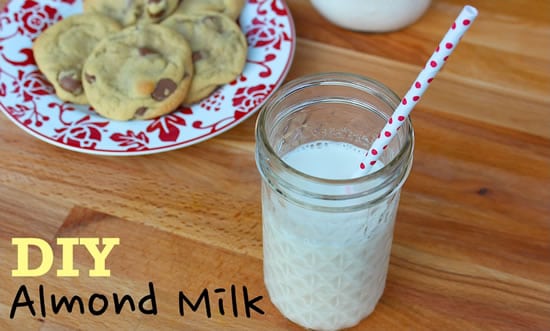
When I committed to October Unprocessed last year for the first time, I didn’t think it would be that big of a challenge considering how I eat already. I am a whole foods kind of girl. Already, when I go to my local co-op, I buy one-ingredient items or produce. I’ve already gotten into the habit of “processing” from scratch the foods I want to eat, such as condiments and bread.
But when the month began and I took a closer look at my daily food choices, I realized I had room to grow. I took on the challenge with gusto as an opportunity to learn how to make the processed foods I do indulge in. I came to realize that going unprocessed does not mean totally abandoning the foods I love or surviving a month of diet-like denial.
Often we buy processed foods out of convenience, thinking it would be too complicated, time-consuming or just plain impossible to make them from scratch. Well as it turns out, almond milk, a processed food I used to buy on a regular basis, is not. A product that used to come from the store in a tetra pak now sits in a mason jar in my fridge, with an ingredient list that consists solely of water and almonds.
A result of last year’s challenge has now become a seamless part of my weekly routine and a constant reminder of how easy and satisfying going unprocessed can be.
As far as the economic benefits are concerned, I was able to get about three cups of raw almonds out of a pound, which yields about three quarts of almond milk. Considering that I spent around $6 for the almonds and usually spend $2 – $2.50 on a container of almond milk, I pretty much broke even as far as cost was concerned.
However, the benefit that comes with making your own almond milk, besides the pride, is being able to make the quantity you want. Drinking a quart of almond milk can be a little bit of a challenge for one girl, but being able to make just a pint, which is not an option with commercially produced non-dairy milks, is priceless. Also, the almond paste bi-product I strain out makes a great, protein-tastic addition to a smoothie.
Let’s also consider packaging. Like I said, I was able to get three quarts of almond milk out of one package of Trader Joe’s raw almonds. So theoretically, I went from three rectangular containers to one plastic bag. Better yet, when I buy my almonds in bulk with my reusable produce sack, I’m down to no packaging at all! Score!
So, the verdict? Making your own almond milk is totally worth the effort and makes me happy every week! Check out this short video to see just how easy and fun it can be!
https://www.youtube.com/watch?v=-ANZ5XpuH5M

Almond Milk
Ingredients
- 1 cup raw almonds
- 4 cups water, plus more for soaking
Instructions
- Put the almonds in a mixing bowl and cover with water. Let sit for at least 6 hours.
- Strain the almonds and put in a blender with 4 cups of water. (It must be a blender, not a food processor – trust my previous experience on this one.) Blend for a full 2 minutes.
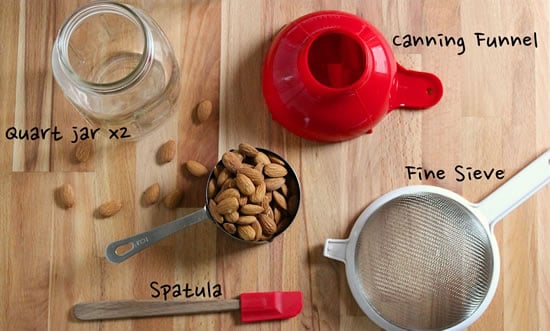
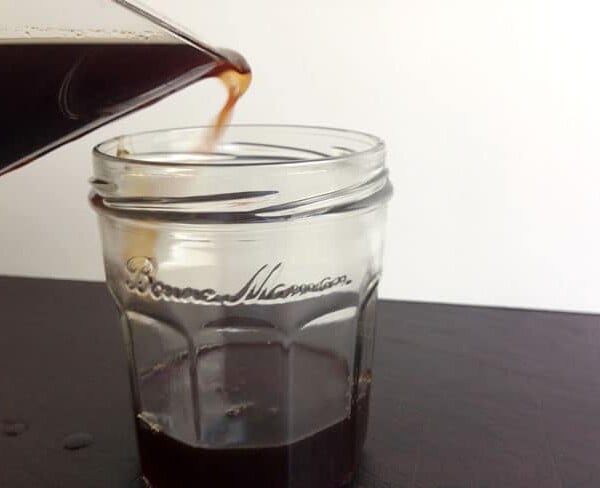
- Strain the blended mixture into a quart-size canning jar using a fine sieve. Press the solids through with a rubber spatula.
- Periodically, scrape the solids from the sieve (save them for smoothies) and rinse the sieve to enable more liquid to pass through.
- Strain the first liquid through the sieve again, this time without pushing the mixture through. What you end up with in that jar is your finished product – DIY Almond Milk!
- Enjoy within 5 days.
Nutrition

Stacy Brewer, teacher, artist, urban farmer, and self-proclaimed garden nerd, is committed to cooking with as many local and seasonal ingredients as possible and raising as much food as she can in her yard. She writes with heart and humor about all things gardening, preserving and crafting on her blog, Seattle Seedling.

















Awesome Recipe Thanks a lot for sharing, the video really helped to understand and complete the job accurately in no time. The almond milk tastes so delicious and I have some info regarding benefits of almond milk which will definitely be a great value to all your readers.
http://www.body-in-balance.org/blog/nutrition/health-benefits-almond-milk/
You shared very useful information about Almond milk that includes many important facts about it. I really liked all information discussed here. Keep up sharing such nice information with us.
Are the leftover solids useful for anything?
For the almond solids I have used them to make crackers,hummus and cereal but I recently discovered that I can keep using them to make more almond milk immediately or later.
How to make whole o gluten free cookies, humus, and crackers with the letover from the almond milk. Thank you.
Is the nutritional value similar to processed? I.e. calories etc.?
Thanks for the easy recipe and directions! I soaked 2 cups almonds overnight, and blended the next day in 2 batches. The first batch I did plain. Mthe 2nd batch I added a Tbls of agave nectar and a pinch of cinnamon to sweeten it up a bit for the kiddos! Both kinds turned out great! I am going to try and freeze 2 of my 4 mason jars I filled so I have accessible almond milk for another week! Thanks again!
I have been looking for an alternative to cows milk because I believe it could be causing eczema in our family. We have tried lactofree milk, which I think is better but it costs a lot of money and with 4 children, they get through ALOT. I have tried Oat Milk and now Almond Milk thanks to your recipe. I think they make a great alternative although the children are less convinced but in hot chocolate etc they don’t know the difference.. I now use a 50/50 mixture of almond and oat milk and if I’m drinking it on its own I add some maple syrup to make it a little sweeter. Works a treat!! 🙂
this is brilliant! I was losing the will a bit after being diagnosed as lactose intolerant, but this really easy almond milk recipe has just cheered me back up.
I made hot chocolate with it immediately and it was lovely and thick. and I actually love the fact it has bits in it 🙂